
FAQ
The following FAQ was generated by NotebookLM and reviewed by the author.
What is the author’s perspective on Christian unity?
The author believes Christians should unite as a witness to God’s love, focusing on loving one another rather than strict adherence to theological details or social acceptability. They advocate for listening to a broad range of people, even those with whom one disagrees, allowing others to be the ones who create divisions. The key is relationship over perfect theology.
What does the author mean by “crossing the gap” in relation to God?
The author uses the term “crossing the gap” to describe God’s act of reconciliation with humanity through Jesus. God, being infinite, bridged the infinite gap between himself and finite humanity. The author sees their own sharing of experiences as a similar, though infinitely smaller, act of bridging a gap to connect with others. God isn’t just filling in spaces where understanding is lacking, but inviting us to cross gaps with him.
How does the author define “evangelism”?
The author distinguishes between two types of evangelism. One is simply sharing one’s personal experiences with God, which the author is doing in the book. The other, proselytizing, involves actively trying to convert others, which the author is not doing. The author respects an individual’s personal relationship with God as their own business and God’s.
What is the author’s view on the Bible and its interpretation?
The author values the Bible and sees it as inspired writing but does not believe it is the only source of truth. All truth comes from God, regardless of the source. The author acknowledges that the Bible is subject to interpretation, and understanding its message requires considering the context, the audience, and the intent of the original writers. Studying nature, science, and other sources can also reveal God’s word and will.
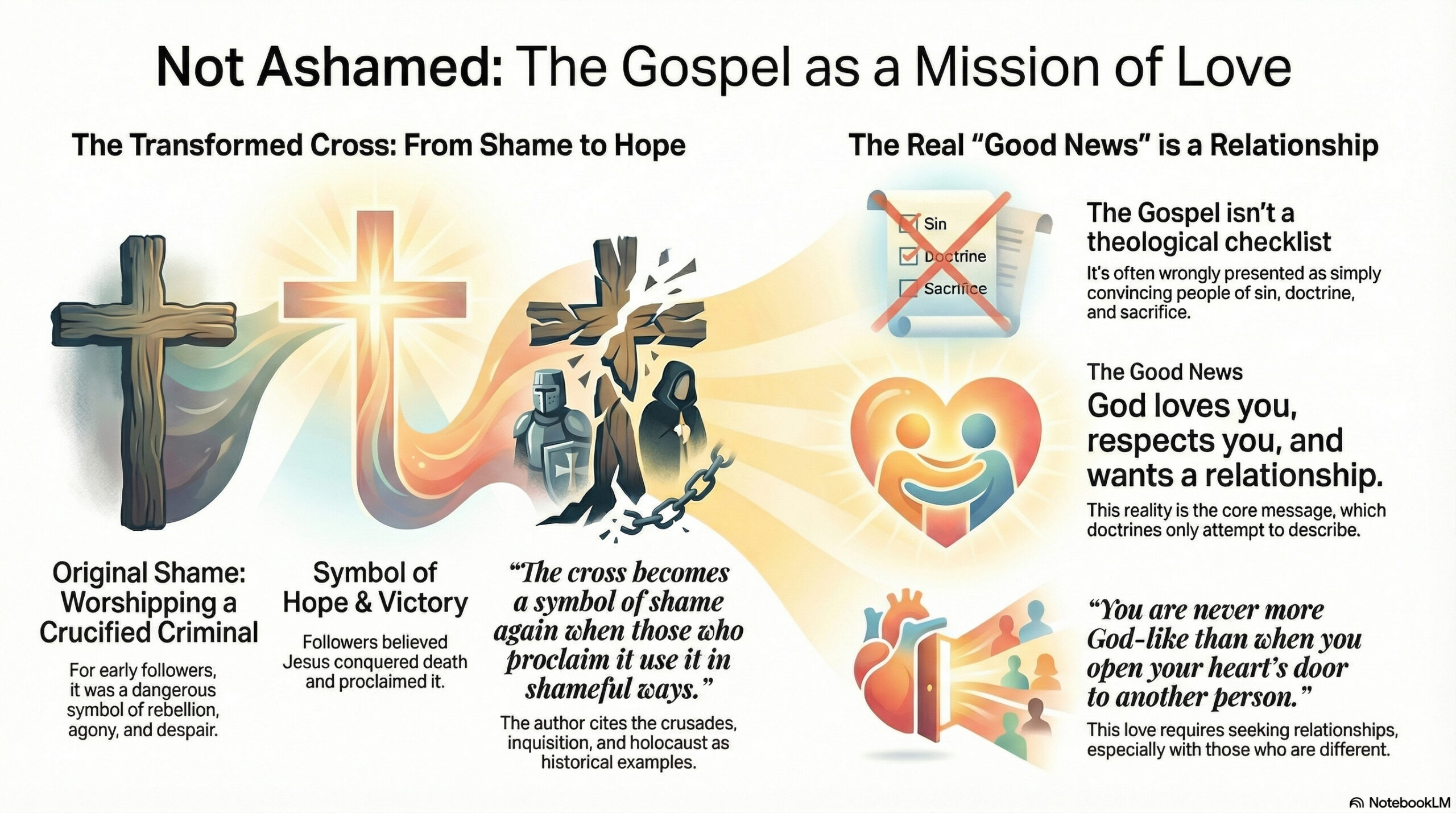
What does the author mean by being “not ashamed of the good news”?
Being “not ashamed of the good news” means embracing the core message of Christianity despite historical or contemporary reasons for potential shame or embarrassment. This involves acknowledging the failings and shameful actions of Christians throughout history, denouncing them, and focusing on the transformative power of Jesus Christ. It also means recognizing that circumstances can be transformed by attitude and how one deals with them.
What is the author’s perspective on miracles and God’s power?
The author believes God’s power is constant and present, not limited to dramatic, extraordinary events. The very existence of the universe is seen as a “big miracle.” The author encourages recognizing God’s power in everyday life and rejects the idea that God only intervenes in specific, isolated instances. God is always involved in the universe.
How does the author view prayer?
Prayer is seen as a means of communication and interaction with God. It is less about changing God’s mind or getting specific requests fulfilled and more about aligning oneself with God’s will and purpose. Prayer is largely about getting on God’s program.
What is the author’s understanding of salvation?
The author views salvation as a restoration of humanity to God’s original intention, which includes autonomy, creativity, and stewardship of God’s power. Salvation is not just about avoiding hell but about becoming better stewards of what God has given. This involves using one’s life, talents, and resources wisely and faithfully. The author sees spiritual healing as possible and restoration of the image of God as a goal of salvation.
(Material on this page was generated by AI, but was also reviewed by the author. Both the author and publisher recommend care and discernment in the use of AI for constructive purposes.)